


How Top Tech Companies Use Server-Driven UI to Move Faster

Open any top mobile app today and you are likely seeing Server-Driven UI (SDUI) in action without even realizing it. These apps can roll out new screens, tweak layouts, or run experiments without waiting for an update because the server is driving the UI. What began as a clever workaround is now a mature pattern powering the fastest-moving product teams. Companies rely on SDUI because it lets them ship changes instantly, personalize deeply, and keep every platform perfectly aligned.
What is Server-Driven UI? 。𖦹°‧
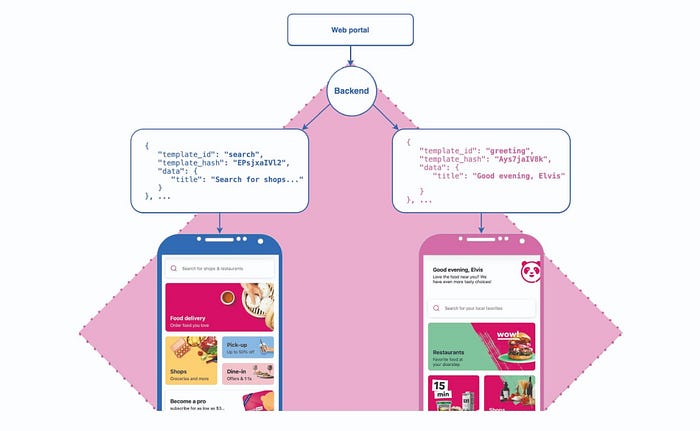
Server-Driven UI flips the traditional mobile model. Instead of shipping every screen’s structure, layout, and content inside the app binary, the backend returns a description (JSON, XML, etc.) telling the app which components to render, how to arrange them, and which actions to attach. You can change UI and content without redeploying — skipping app store approvals entirely.
Think of it like the web: a browser does not know a webpage in advance; it simply interprets HTML and renders it. SDUI works the same way. The app understands a library of predefined components, while the server decides which ones appear and how they fit together.

Companies actively building with SDUI 🤝
SDUI has gained significant traction over the last few years. Large enterprises have contributed massively to its growth and adoption. Here’s a non-exhaustive list of companies and how they are using SDUI:
- Netflix — enabling targeted lifecycle flows
- Airbnb (Lona & Ghost) — faster rollout and layout consistency across platforms (know more)
- Delivery Hero (Fluid) — reducing time to market (know more)
- Uber — enabling rapid development and safe experimentation
- Shopify — improving merchant experience via personalization (know more)
- Meta — rapid iterations and experimentation
- Lyft — reducing business complexity and increasing release velocity (know more)
- PhonePe (LiquidUI) — making product maintenance and updates easy and efficient (know more)
- Zalondo (Appcraft) — enabling dynamic user personalization (know more)
- Nubank (BDC) — improving dev speed, control, and time to market (know more)
& many more :)
Use cases where SDUI shines! ✨
SDUI is useful across repeated and high-impact product scenarios:
- Faster product iteration & update adoption — Real-time mobile updates hit 100% of users instantly, bypassing app store approvals.
- Feature experimentation & A/B testing — Swap entire screens or UI treatments from the server to run massive experiments without new binaries.
- User personalization — Serve different layouts or CTAs per cohort, eligibility, or behavior. Netflix uses SDUI to manage lifecycle touchpoints directly from the backend.
- Cross-platform parity — Keep web, Android, and iOS aligned through a single source of truth rendered natively per platform.
- Fast rollback and flow control — Disable or tweak problematic flows, payment paths, or regional content instantly from the server.
Enterprise case studies 🏢
Below are condensed takeaways from public engineering posts and talks.
Airbnb / Ghost
Source: The Airbnb Tech Blog
Airbnb loves SDUI so much they built multiple internal systems (Lona & Ghost). Ghost — their Server-Driven UI platform — enables rapid iteration and safe launches across web, iOS, and Android.
“The Ghost Platform (GP) is a unified, opinionated, server-driven UI system that enables us to iterate rapidly and launch features safely across web, iOS, and Android.”
GP provides native frameworks (Typescript, Swift, Kotlin) so developers can create server-driven features with minimal setup. The system revolves around a unified GraphQL schema defining reusable “sections” and “screens.” Clients interpret the instructions in their native languages, enabling consistent experiments, updates, and fixes.
Airbnb continues to invest in more composability and tooling so designers and non-engineers can configure UI without heavy client-side work. The shift to SDUI has created a more flexible, maintainable, and scalable product development pipeline.
Delivery Hero / Fluid
Source: Delivery Hero Tech Blog
“Fluid is our SDUI platform that decouples the UI from the app release cycle. It reduces our time to value by facilitating rapid product iterations.”
Fluid addresses release bottlenecks, low update adoption, duplicated logic, and rigid apps. The platform revolves around templates, widget models, and widget factories. A template represents a reusable UI fragment; the client decodes it to create native UI dynamically. Fluid supports offline caching, type-safe data binding, and versioning to guarantee forward/backward compatibility. Design constraints are applied via a template editor, so teams retain flexibility while staying consistent.
Nubank
Source: Nubank Blog
“Backend Driven Content (BDC) works as a Lego manual for the Nu app. It tells how to use the ‘building blocks’ available to build the interface to the end user.”
BDC helps Nubank deliver frequent updates across its app ecosystem. Instead of embedding layouts and interactions in the client, the app receives instructions from the backend for what to render and how it should behave. The shift unlocked controlled rollout, A/B testing, and real-time UI adjustments without waiting on app stores.
BDC is aligned with Nubank’s design system and tech stack (Flutter for mobile, Clojure for backend). Roughly 70% of new screens and 43% of the app now run on BDC, thanks to a culture of experimentation, collaboration, and developer advocacy.
When SDUI is not the right fit 🚫
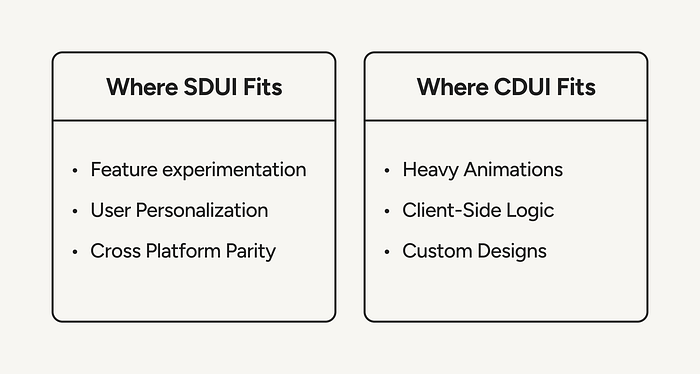
SDUI is powerful, but not everything should be server-driven. Traditional client-driven approaches work better for:
- Heavy animations or game-like interactions — Complex motion, custom gestures, or high FPS flows should stay native.
- Screens with deep client-side logic — If the experience depends on local state, offline logic, or rapid calculations, SDUI can complicate things.
- Highly custom screens that rarely repeat — Modeling bespoke surfaces in SDUI may cost more than the benefit.
- Performance-sensitive surfaces — Camera views, editors, maps, AR layers need direct native rendering.
- Weak design systems — SDUI thrives on strong design systems and stable component libraries. Constantly changing inventories make it harder to maintain.
Open-source tools & frameworks 🛠️
Several open-source projects make it easier to implement SDUI:
- Stac (Flutter) — Website | GitHub. A flexible framework paired with the Stac CLI and Stac Cloud so you can build, update, and ship dynamic interfaces instantly.
- rfw (Flutter) — Pub | GitHub. Maintained by Flutter, providing a declarative runtime-rendering model.
- Divkit (Multi-platform) — Website | GitHub. Roll out server-sourced updates to iOS, Android, and Web, and prototype UI fast.
- Rise Tools (React Native) — Website | GitHub. Tweak and expand React Native surfaces in production without redeploying code.
Outro ⭐
At Stac, our mission is to advance the future of Server-Driven UI and bring its full potential to the Flutter ecosystem. SDUI delivers clear advantages for almost every type of app, yet awareness and adoption still lag behind. We’re committed to changing that.
If you want to follow our journey more closely, join the Stac Discord community and give us a star on GitHub. Your support helps push the SDUI ecosystem forward.